Results a clinician can read at a glance
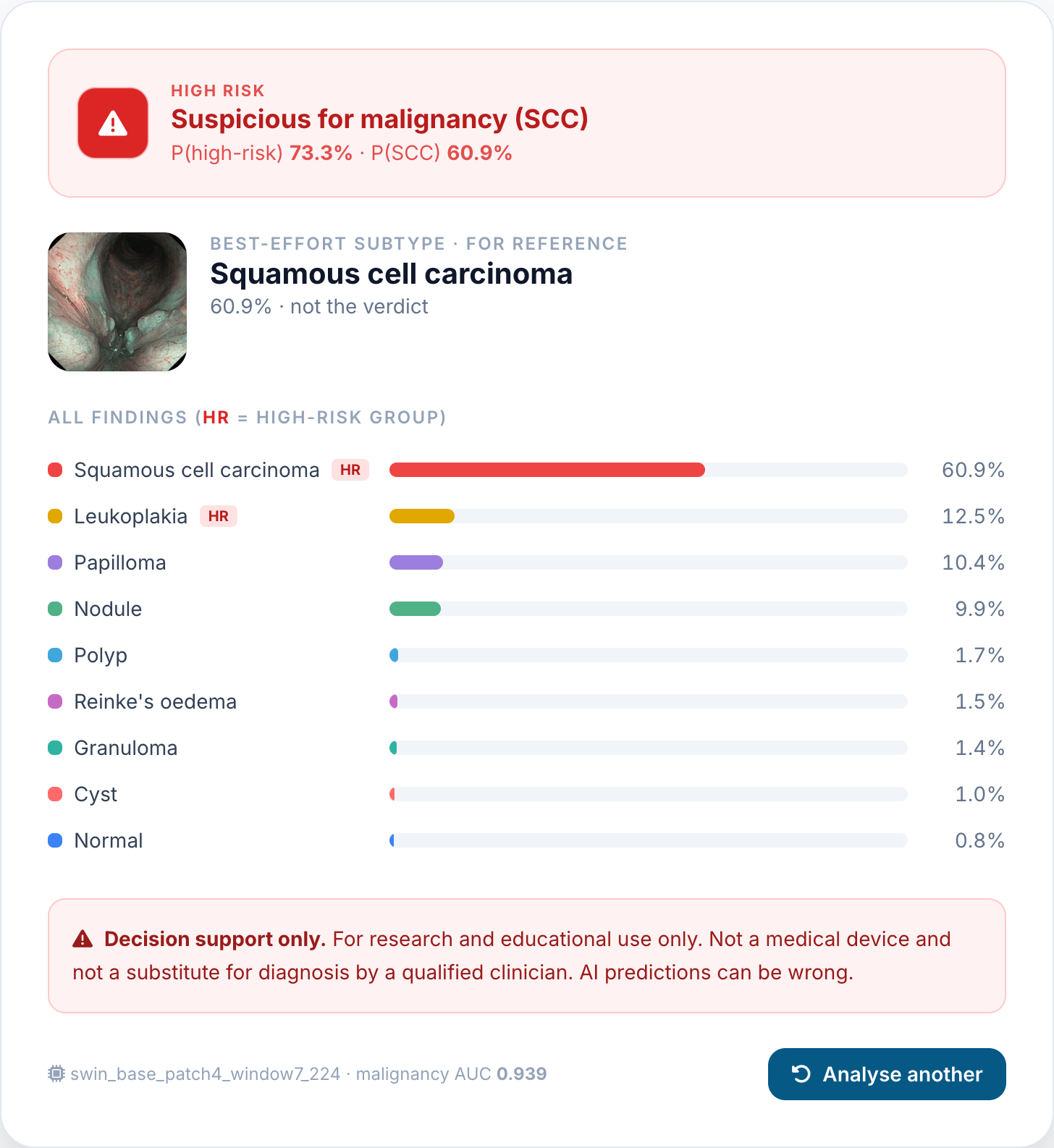
The triage call leads. The nine-way subtype is shown underneath as a reference, clearly labelled as the weaker signal — because that is what it is.
voxlensai.online
Laryngeal cancer screening
VoxLensAI reads a single laryngoscopy image and returns the call that actually changes what you do next — high risk or low risk — with the probability behind it.
86.9%
High-risk sensitivity
0.94
Malignancy AUC
<5s
Per image
High risk
Suspicious for malignancy
P(high-risk) 91.4% · P(SCC) 78.2%
Decision support only · verify clinically
Laryngeal cancer is highly curable when caught early and brutal when it isn't. But the decision at the scope is rarely "which of nine lesions is this" — it's does this patient need urgent referral and biopsy, or routine follow-up?
So that is what VoxLensAI answers. It groups leukoplakia and squamous cell carcinoma as high risk and everything else as low risk, a framing defined by our clinical lead rather than by the model's architecture.
This is also where the model is strongest. Most of its mistakes are leukoplakia-versus-carcinoma swaps — which do not change the referral decision. Judged on the triage call it reaches 86.9% sensitivity and 88.7% specificity, meaningfully better than its fine-grained subtype accuracy.
Tuned for sensitivity, on purpose
The malignancy threshold is deliberately low. Missing a cancer costs far more than an unnecessary second look, so the model is biased toward flagging.
One still image is enough
No video, no special hardware, no voice recording. Any laryngoscopy frame from equipment you already own.
Built with ENT surgeons
The risk grouping, the label taxonomy and the error review all come from practising laryngologists, not from a benchmark leaderboard.
The triage call leads. The nine-way subtype is shown underneath as a reference, clearly labelled as the weaker signal — because that is what it is.
Two of them — leukoplakia and squamous cell carcinoma — define the high-risk group.
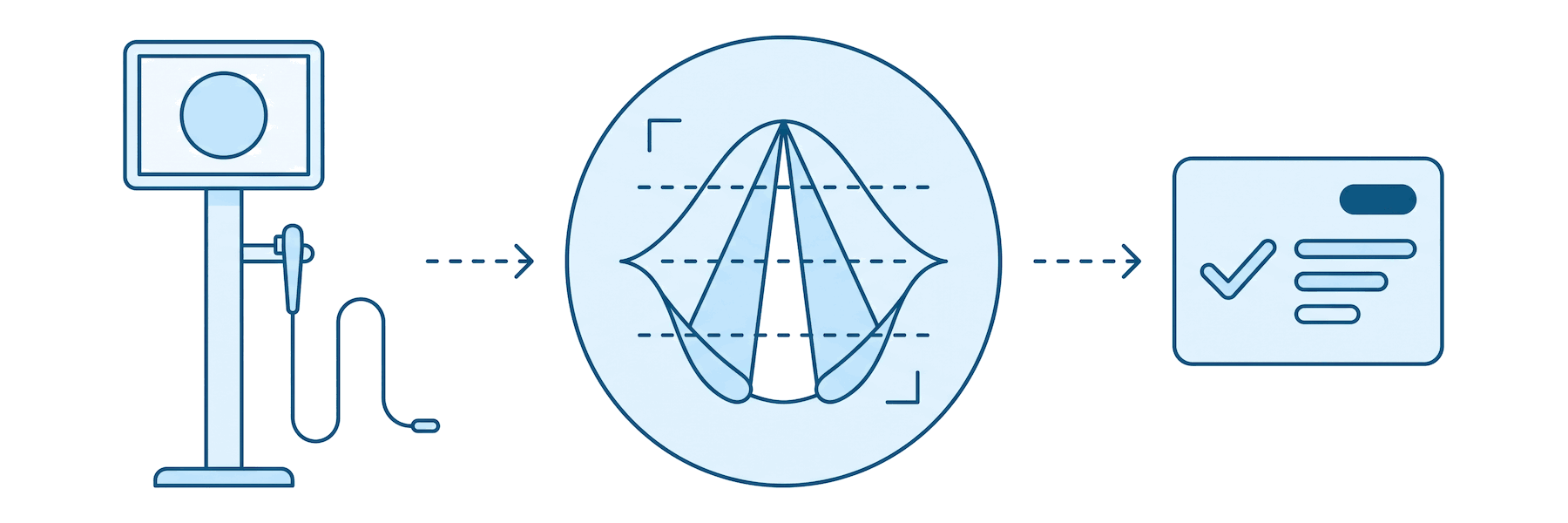
1
Capture
Save a single frame from any laryngoscopy or stroboscopy system. JPG or PNG, no particular resolution required.
2
Analyse
A Swin transformer trained on annotated laryngoscopy images scores all nine findings and sums the high-risk probability mass.
3
Triage
You get high risk or low risk with the numbers behind it, plus the subtype breakdown for context. Your judgement decides.
Dr. Shashidhar T.B.
ENT Surgeon · Co-founder
Leads clinical direction across VoxmedAI's imaging products, including OtoSensAI.
Dr. Rakesh Srivastava
ENT Surgeon · Co-founder
Defined the high-risk / low-risk framing this screener is built around, and reviews the model's errors against real laryngoscopy practice.
Access is invitation-only during early testing. Sign in with Google using the invite code from your invitation email.
Sign in with GoogleVoxLensAI is open to ENT surgeons, laryngologists and clinical researchers during early testing. Tell us a little about your practice and we'll send an invite code.